The short answer: To price a house to sell in late 2026, sellers must price against active competing listings rather than only past sales, budget for buyer concessions (which appear in 44.7% of sales), and adjust strategy within 2 to 3 weeks if showing feedback stalls. With mortgage rates keeping buyers selective and Northern Virginia inventory sitting at 6,105 active listings (3.1 months of supply) as of October 2026, accurate day-one pricing is the single biggest factor separating fast sales from stale listings.
1. Why Should You Price for Your Competition, Not Just the Comps?
You should price for your active competition because buyers compare your home to the other houses currently for sale today, not the homes that closed three to six months ago.
Comparable sales (comps) are recently closed properties similar to yours in size, location, and condition. While comps establish a historical baseline, they are a rearview mirror. In a shifting market—such as Fairfax, Loudoun, Prince William, Arlington, and Alexandria, where median Days on Market reached 29 days in October 2026—active inventory dictates what buyers perceive as fair value right now.
A data backed pricing strategy evaluates three layers before setting an asking price:
Closed sales (Comps): Pricing should be grounded in what buyers are willing to spend, recent sales (preferably within the last 3 to 6 months) of comparable properties within the same local area and school district.
Pending listings: Shows the list price point where buyers are making offers right now, however, final sales price may be different from list price.
Active competition: Reveals how your home’s condition, updates, and layout stack up against every other property a buyer will tour this weekend. Pricing a home correctly accounts for current active buyer preferences, demand, and competing inventory.
Property Value Drivers: Features such as square footage, additions, location (e.g., cul-de-sacs), and major amenities (like a multi-car garage or high-end interior renovations) significantly adjust the target listing price upwards.
The goal is not to be the cheapest house in the neighborhood—it is to be the clearest value on the buyer’s shortlist. As Jake Krimmel, Senior Economist at Realtor.com, explains:
“Pricing to today’s demand is helping homes move and keeping more transactions alive in a high-rate environment.”
2. Why Do Buyers Still Negotiate When a Home Is Priced Right?
Buyers still negotiate on well-priced homes because elevated mortgage rates force them to protect their cash at closing and lower their monthly payments.
Seller concessions are financial contributions a seller agrees to pay on the buyer's behalf—such as closing-cost credits, repair allowances, or mortgage rate buydowns. Asking for a concession is rarely a sign that your home is overpriced; it has simply become standard negotiation in today’s market.
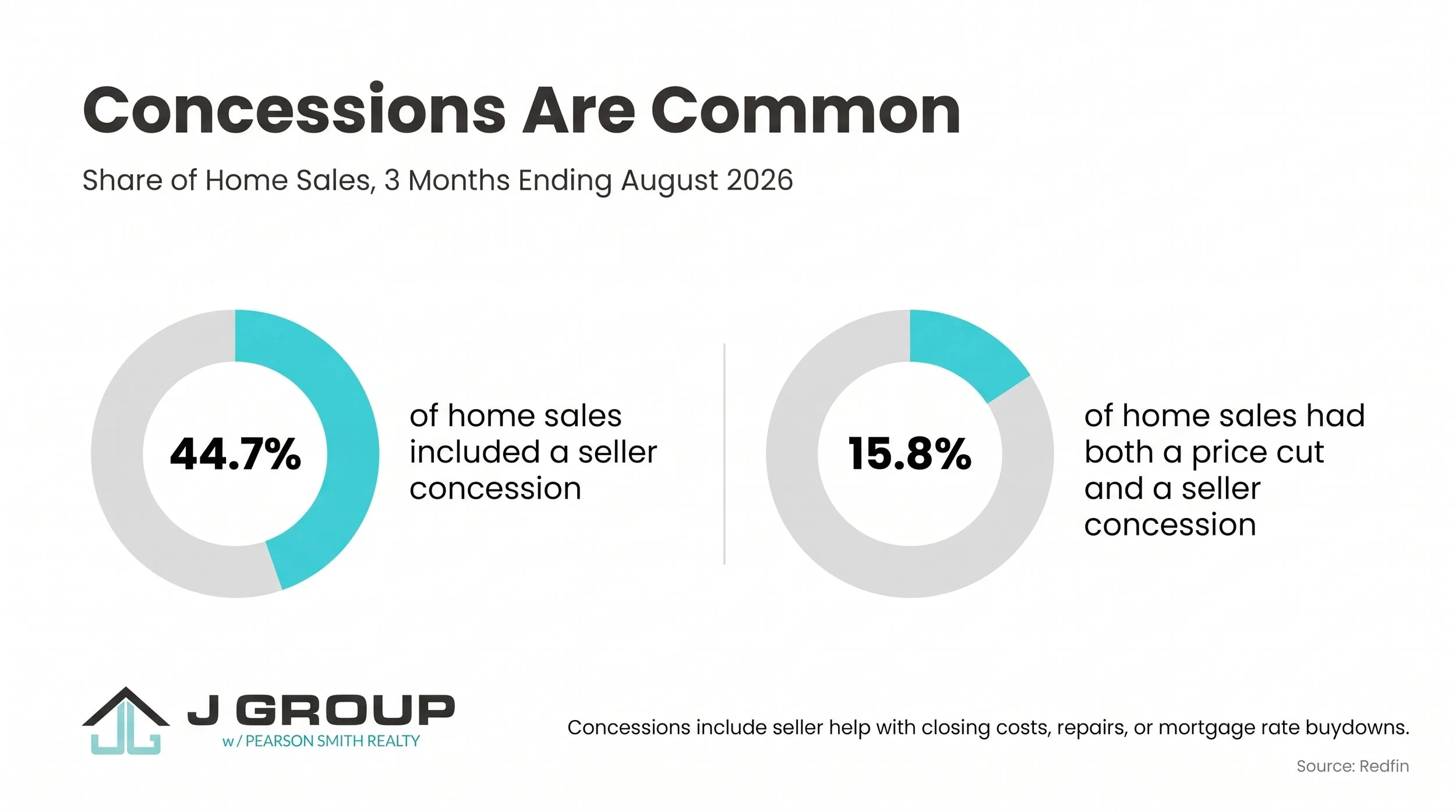
According to Redfin data:
44.7% of home sales now include seller concessions (nearly half of all transactions).
15.8% of home sales involve both a price reduction and a seller concession.
You do not have to accept every buyer request. Sometimes holding firm on price and terms is the right call; other times, offering a targeted closing-cost credit or temporary rate buydown is what keeps a qualified buyer from walking away. Always evaluate the net proceeds of the full offer—not just the headline purchase price—before deciding how to counter.
3. How Do You Know When to Adjust Your Selling Strategy?
You should evaluate your listing strategy after 14 to 21 days on the market by matching buyer behavior—online views, showings, and offer terms—to the specific bottleneck.
A slow first few weeks does not automatically mean you need a steep price cut. Dropping the price only works if price is the actual objection. Use the diagnostic framework below to read what the market is telling you:
High online views, few showings
Likely Root Cause: Listing photos, description, or curb appeal fail to convert clicks into tours.
Recommended Strategic Adjustment: Upgrade photography, refresh the lead image, rewrite remarks, or improve exterior presentation. Then relaunch the listing.
Steady showings, no offers
Likely Root Cause: Price-to-condition gap compared to active competing listings. potential buyer see the home in person, and can’t justify making an offer.
Recommended Strategic Adjustment: Address condition/staging objections or execute a targeted price adjustment.
Offers received, weak terms
Likely Root Cause: Buyers want the home but are testing affordability or leverage.
Recommended Strategic Adjustment: Shift negotiation strategy, but be open to negotiate a lower price (e.g., counter with a rate buydown credit).
Tracking showing feedback alongside weekly shifts in local inventory lets you make surgical adjustments before your listing accumulates high Days on Market.
Frequently Asked Questions About Home Pricing
Should I price my house higher to leave room for negotiation? No. Overpricing to leave "wiggle room" typically backfires in a selective, higher-rate market. Buyers filter searches by strict price brackets and compare your home directly against active competition; an inflated asking price often prevents qualified buyers from scheduling a showing at all, leading to longer Days on Market and larger price cuts later.
What are the most common seller concessions buyers ask for right now? The most common seller concessions are closing-cost credits, seller-paid mortgage rate buydowns (such as a 2-1 temporary buydown), and repair credits negotiated after the home inspection. According to Redfin, nearly half (44.7%) of recent home sales include at least one seller concession.
How long does it take to sell a house in Northern Virginia right now? Based on Bright MLS data for October 2026 across Fairfax, Loudoun, Prince William, Arlington, and Alexandria, the median Days on Market (DOM) is 29 days, with a median sold price of $704,250. Turnkey, competitively priced homes continue to sell faster, while overpriced listings sit significantly longer. However, average days on market is slowing, here is my 2027 market forcast for Northern VA — https://www.jgrouprealty.com/blog/2026/11/19/northern-virginia-real-estate-forecast-2027-are-we-entering-a-balanced-market
When should a seller consider a price reduction? A seller should review market performance after 2 to 3 weeks of active showings. If the home is generating strong online traffic and consistent in-person tours without producing offers—and feedback points to value compared to competing homes—a strategic price adjustment is usually more effective than waiting 30 to 60 days.
About the Author: Joey Remondino leads J Group w/ Pearson Smith Realty, serving home buyers and sellers across Northern Virginia (Fairfax, Loudoun, Prince William, Arlington, and Alexandria). Ready to see how your home stacks up against today’s active competition? Visit JGroupRealty.com or call (703) 972-1699 to build your custom pricing strategy